Helicone vs Langfuse in 2026, and When LLMtrack Fits Instead
Helicone has been in maintenance mode since March and Langfuse is now part of ClickHouse. How the two compare in November 2026 on price, setup and cost tracking, and when a cost-only tool is the better pick.
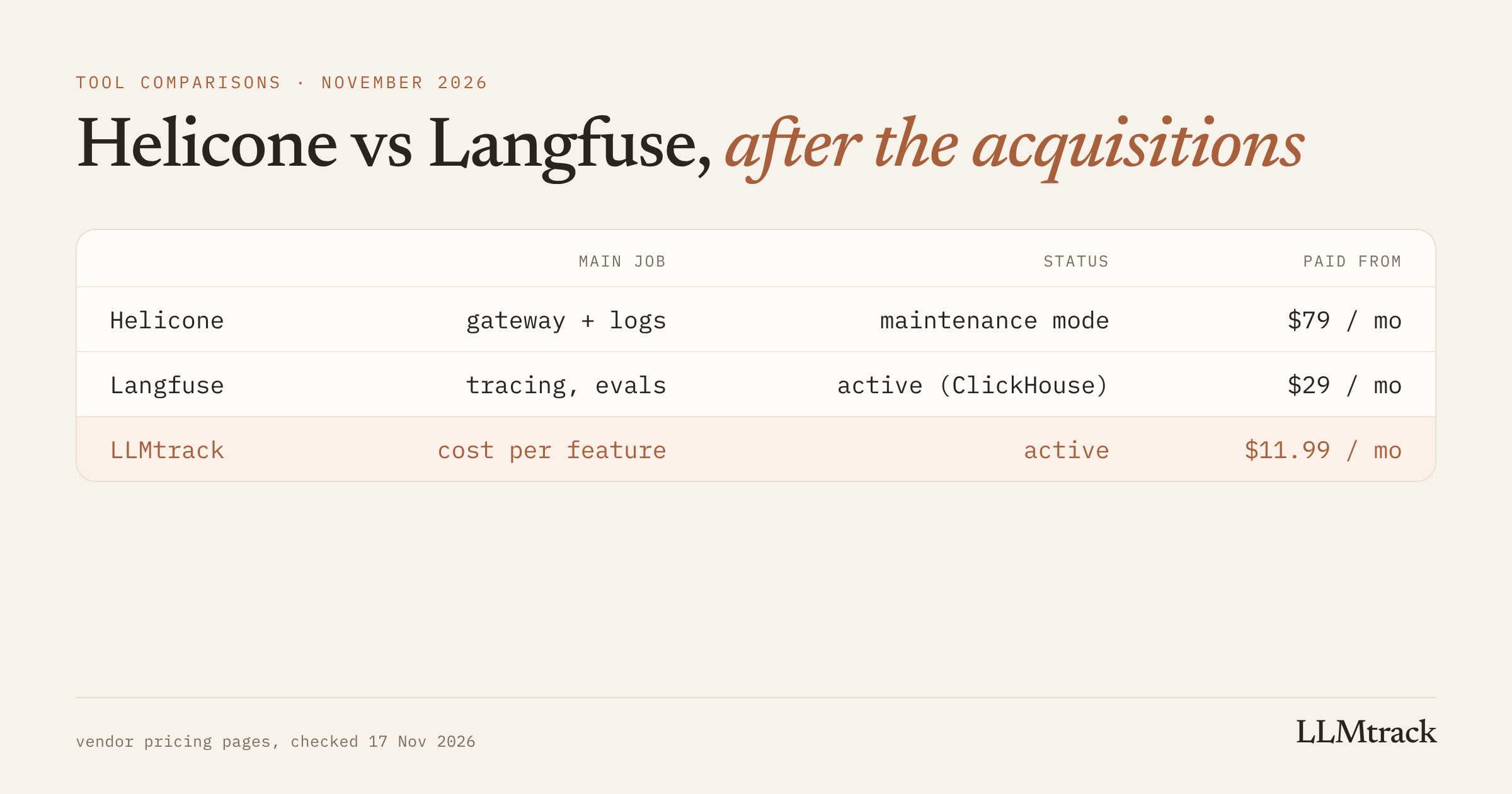
Helicone and Langfuse used to be the two names every solo builder compared when they first wanted to see what their LLM calls were doing. Both changed hands this year. Langfuse joined ClickHouse in January, and Helicone joined Mintlify in March and went into maintenance mode. Portkey, the other common pick, was bought by Palo Alto Networks in May. Three of the most-recommended tools changed owners in five months, which is worth knowing before you build on any of them.
I build LLMtrack, which overlaps with both on one job, cost, and does none of the rest. So this comparison tries to be straight about where each one wins.
This post is part of the "Choose" section of the complete guide to LLM cost optimization. Every fact below was checked on each vendor's own pages on 17 Nov 2026.
What changed in 2026
- Langfuse joined ClickHouse in January. It says Langfuse Cloud keeps running as it was and that it stays open source and self-hostable.
- Helicone joined Mintlify on 3 March. Its announcement says the service stays live in maintenance mode, with security patches, support for new models, and bug and performance fixes. Its open-source repository is still public.
If you're picking a tool now, that difference matters more than any single feature.
How they're built
Helicone is a gateway. You point your base URL at Helicone, and it logs each request on the way through, with caching, rate limits and fallbacks on top. It sees every prompt and response because it sits in the middle.
Langfuse is an engineering platform built around traces. It records what each step of a chain did, and adds evals and prompt management. It also tracks cost: its docs say it breaks cost down by model, tags and users, and prices cached, audio and reasoning tokens as separate usage types.
LLMtrack tracks cost after the response. Your app calls the provider as normal, then sends token counts and labels. It doesn't see prompts, doesn't trace chains, and can't block a request.
Side by side
| Helicone | Langfuse | LLMtrack | |
|---|---|---|---|
| In the request path | Yes, as a gateway | No | No, one async call after the response |
| Main job | Gateway and request logs | Tracing, evals, prompt management | Cost per feature and customer |
| Cost against what each customer pays | Not listed | Not in its cost docs | Yes, margin per account |
| Self-host | Yes, open source | Yes, open source | No, hosted only |
| Free plan | 10,000 requests a month | 50k units a month, 30 days of data, 2 users | 3,000 requests a month, 30 days, every feature |
| Paid plans | Pro $79/mo, Team $799/mo | Core $29/mo (100k units, 90 days, unlimited users, $8 per extra 100k), Pro $199/mo (3-year retention) | Pro $11.99/mo for 25,000 requests |
| Status | Maintenance mode since March 2026 | Active, part of ClickHouse | Active |
Langfuse meters "units" (traces, observations and scores) while Helicone and LLMtrack count requests, so the free tiers aren't directly comparable. A single traced chain in Langfuse can be several units.
Which one to pick
- Langfuse if you debug with traces, run evals, manage prompts, or need to self-host. It's the most complete of the three for engineering work.
- Helicone if you already run it and its caching or fallbacks are doing real work. For a new project, a gateway that's still being developed is the safer start: Portkey vs LiteLLM vs OpenRouter compares the main options.
- LLMtrack if the question is the bill: which feature spends the money, which customers cost more than they pay you, and the day you'll cross your budget.
Running Langfuse and LLMtrack together is common, and the two don't conflict: Langfuse answers what a chain of calls did, LLMtrack answers what it cost and who it cost it for. If you're leaving Helicone, the Helicone alternative for LLM cost tracking covers the move step by step. If Langfuse feels like more than you need, here's the lightweight Langfuse alternative.
Adding LLMtrack takes one call
LLMtrack does AI cost tracking per feature, model and customer from one call after each response. Install the Node or Python SDK, then:
import { LLMtrack, fromOpenAIUsage } from 'llmtrack'
const llmtrack = new LLMtrack({
apiKey: process.env.LLMTRACK_API_KEY,
onError: (e) => console.warn(e.code, e.message),
})
const res = await openai.chat.completions.create({ model, messages })
llmtrack.track({
provider: 'openai',
model: res.model,
feature: 'summarizer',
customerId: 'acme-corp',
...fromOpenAIUsage(res.usage),
})Each request is priced component by component from each provider's published schedule, re-synced daily on the LLM API pricing sheet. Prompts are never sent. You can start on the free plan, no card needed.
For the wider field, including gateways and other trackers, see LLM cost tracking tools compared.
FAQ
Not according to Helicone. Its March 2026 announcement says the service stays live in maintenance mode, with security patches, new-model support and bug fixes still shipping, but no new features.
Yes. Langfuse says it stays open source and self-hostable, and that its cloud keeps running as it did before.
Langfuse Cloud has a free Hobby plan with 50,000 units a month, 30 days of data and 2 users. Core costs $29 a month with 100,000 units, 90 days of data and unlimited users, then $8 per extra 100,000 units. Pro costs $199 a month and adds 3-year retention. Self-hosting the open-source version is free.
Yes. Use the tag you already give each call in Langfuse as the LLMtrack feature, and your Langfuse user ID as the customer ID, so the two dashboards line up.
It depends on volume and on what's metered. Helicone counts requests, Langfuse counts units, and LLMtrack counts requests: free up to 3,000 a month, then $11.99 a month for 25,000.
Sources
Checked on 17 Nov 2026:
See what each feature costs, from your next request
Free plan with every feature. One async call, no proxy, no card.
Start tracking free →